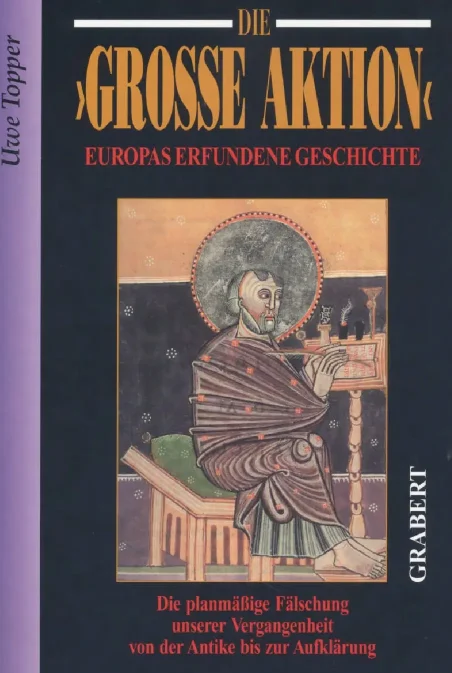
The Great Action
Manuscript August 1999
Uwe Topper
DIE „GROSSE AKTION“
Grabert (publisher), Tübingen 1998
Paperback, 286 pp. , 23 fotos and many drawings. DM 32.- ISBN 3-87847-172-6
Download the full German text in PDF: DIE „GROSSE AKTION“
The Great Action – How Europe’s History was produced
The well known fact that most European medieval documents are forged, written much later and falsified or at least giving distorted information, has so far not been carried to its final conclusion: our whole historiography until the 16th century is fabricated and resembles rather a great novel than an earnest essay to reconstruct historical facts.
Analysing certain famous “chronicles” or contemporaneous reports such as the works of Tacitus (“Agricola” and “Germania”) or the writings of Roswit of Gandersheim (10th cent.), Topper comes to results – already proclaimed since the last century by academic scholars – that they are all invented, mostly in the 15th and 16th century. Our great Humanists like Erasmus of Rotterdam or Conrad Celtes, Nicolaus Cusanus or Piccolomini (later pope Pius II) and many of their colleagues excelled in writing history under new aspects, using legends and hearsay for their world-chronics.
Viewing other examples like Marc Aurel’s “Memoirs” or the “Golden Donkey” of Apuleius, the author prooves with accuracy that they cannot have been written in Roman Antiquity but are the product of Renaissance writers who step by step perfected their fabric.
To talk about conspiracy has no meaning in this context. The “Great Action” was chaotic, hazardous, without central planing, and that is why we can detect so many mistakes. There have even lived a number of respected scholars and churchmen who resisted this behaviour and tried to get down to more trustworthy historiography, mostly in vane. Yet their fight against official lies still gives us some idea of the problem. Among the many outright scholars are mentioned Jean Hardouin, Jean de Launoy and Barthelemy Germon.
The great Isaac Newton was well aware of the chronological and dogmatic discussion of his time and followed it with astuteness during four decades until his death. Although it would be unrealistic to enhance his arguments nowadays, his postume book on Chronology still gives us an idea of how vague and uncertain all knowledge about the past has been and how it was put together with the result that we now believe to hold documents in hands where in reality novels and faked chronicles suggest a written history going back as far as thousands of years.
Other scientists, most prominently some German philologists of the 19th and early 20th centuries, like Aschbach, Baldauf or Kammeier, were able to detect many cases of fraud and gave a good idea of the “Great Action” of the church, thereby unveiling fables and inventions we had taken for real.
Summing up all these efforts, the author adds new insights that had never been thought of. He can show how even Chinese history has been worked upon by the Catholic church and finally been accepted by Chinese scientists. Islamic and Jewish history is no less affected. In the end a new idea comes forth, a new way of looking at historiography, worthy to be considered by modern historians.



2 Comments
Von Rho
What about De Arcilla mentioned by Fomenko?
Rainer Schmidt
Because it simply makes no sense to dwell on fantasies.
There is no reliable biographical data or academic publications on a person of this name in the 16th century in academic research or in standard sources on the history of the University of Salamanca, except for Nikolai Morozov, who is then taken up by the charlatan Fomenko. The name de Arcilla does not appear in any known university lists of Salamanca, nor in humanistic correspondence or early bibliographies (e.g. by Nicolás Antonio), and Morozov only vaguely mentions it in the preface to Volume VII of his ‘Христос’ (Christ). And he only does so in this passage, with the words:
“Так профессор Саламенского университета де Арсилла (de Arcilla) ещё в XVI веке опубликовал две свои работы «Programma Historiae Universalis» и «Divinae Florae Historicae», где доказывал, что вся древняя история сочинена в Средние века, и к тем же выводам пришёл иезуитский историк и археолог Жан Гардуин (J. Hardouin, 1646—1724), считавший классическую литературу за произведение монастерионцев предшествовавшего ему XVI века.”
(As early as the 16th century, Professor de Arcilla of the University of Salamanca published two of his works, Programma Historiae Universalis and Divinae Florae Historicae, in which he proved that all of ancient history was invented in the Middle Ages. The Jesuit historian and archaeologist Jean Hardouin (J. Hardouin, 1646–1724) came to the same conclusions and regarded classical literature as the work of monks from the previous 16th century.)
Morozov otherwise uses real names correctly, even if he misinterprets them. If he meant a well-known humanist, he would have named him to gain weight. The choice of an unknown name rather weakens his position – unless he himself considered it to be real. This suggests that Morozov either trusted a false secondary source or accepted an anecdotal tradition without checking it. For neither of the two alleged works by the mysterious Professor de Arcilla (‘from clay’), which are mentioned by Morozov – and only by him! – without any references, seems to have ever existed. Neither ‘Divinae Florae Historicae’ nor ‘Programma historiae universalis’.
That said, if you know more about this guy de Arcilla and his works, feel free to provide us more informations. I would be very interested to hear from you, as the famous Jesuit Jean Hardouin was also unaware of this alleged brother in faith.